



A filter failure on a production line often points to something bigger than a “small component” problem. Pump wear, unplanned downtime, quality deviations and rising energy consumption frequently trace back to an incorrectly selected industrial filter. Choosing the cheapest or most readily available product from the catalog may seem practical in the short term, but a filter that doesn’t match the system’s actual operating conditions ends up costing more in the medium term.
Choosing the right industrial filter cannot be based on a single number (such as the micron rating). Multiple variables — from system pressure to the chemical composition of the fluid to the flow rate of the production line — must be evaluated together. In this article, we cover five essential criteria that shouldn’t be overlooked during filter selection, and how each one affects system performance.

1. Micron Rating: Targeting the Correct Particle Size
The micron rating indicates the smallest particle size a filter can capture, and it’s the first criterion that comes to mind when selecting a filter. However, looking at this value in isolation can be misleading.
The component that needs to be protected in a system (pump, valve, cylinder) has a tolerance for a specific contamination class, typically expressed through standards such as ISO 4406. The micron rating required to reach the target cleanliness class is derived from the equipment manufacturer’s technical documentation.
Choosing a micron rating that’s finer than necessary saturates the filter faster and increases replacement frequency; choosing one that’s too coarse doesn’t adequately protect the equipment. That’s why the micron rating should be calculated based on the system’s sensitivity, not chosen by estimation.
Furthermore, the micron rating printed on the box doesn’t guarantee the filter’s actual performance on its own. The beta ratio — which shows the percentage of a specific particle size a filter actually captures — is measured through the ISO 16889 multi-pass test. A filter with a beta ratio of 1000 captures approximately 99.9% of particles at that size, while a filter with a lower beta ratio may be far less effective even if the box states the same micron rating. Requesting this test data from your industrial filter supplier increases the reliability of the selection process.
In practice, this difference shows up quickly in the field. Two filters carrying the same “10 micron” label can produce completely different results when their beta ratios differ. A filter with a beta ratio of 200 captures only 99.5% of particles at that size, while one with a beta ratio of 1000 captures 99.9%. This difference, which looks small on paper, corresponds to a significant change in the amount of particulate accumulating in the system, and directly affects the rate of pump wear over time.

2. Material Compatibility: Chemical Balance With the Environment
An industrial filter is not just a physical particle barrier; it’s a component that operates in continuous contact with a fluid or an environmental condition. The chemical compatibility of the filter material (seal, housing, media) with that environment is the fundamental requirement for sealing performance and filter service life.
For example, seal materials used in hydraulic systems can be made from different rubber types such as NBR, FKM or EPDM. When a seal material incompatible with the chemical composition of the hydraulic fluid in the system is selected, the material swells, hardens or cracks over time, leading to a rapid breakdown in sealing performance.
Similarly, standard stainless steel may not provide sufficient corrosion resistance in filters operating in high-humidity or chloride-containing environments. In such demanding conditions, chrome-plated filters offer longer service life thanks to their surface hardness and chemical resistance. In food and beverage production, material selection must also be evaluated not just for durability, but for compliance with hygiene and product safety standards.
Overlooking material compatibility is a risk that goes unnoticed in the short term but turns into serious failures in the long run. Sharing the technical data of the fluid and environmental conditions used in the system with your filter supplier is the first step toward selecting the correct material.
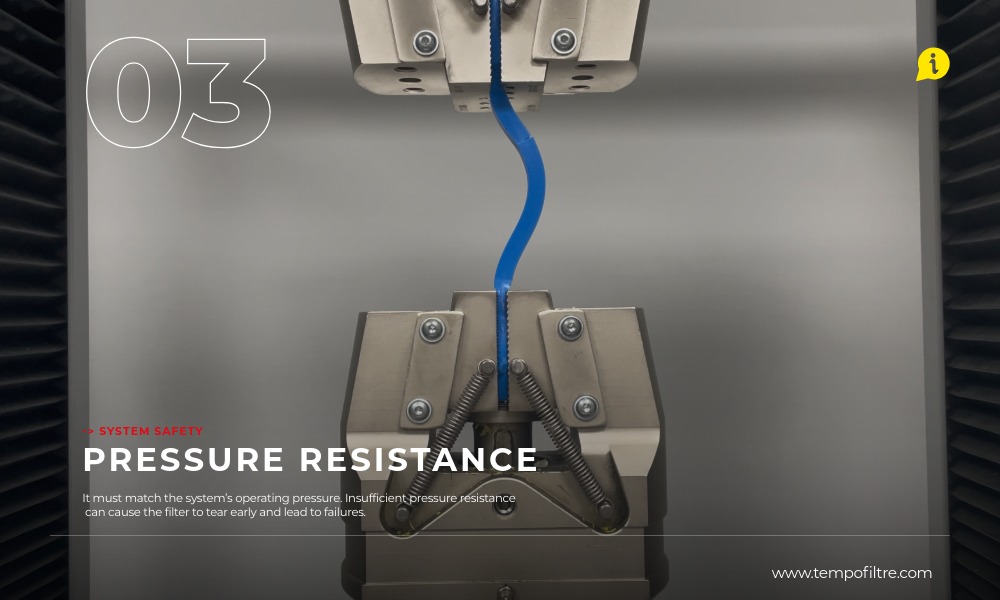
3. Pressure Resistance: Matching the System’s Operating Conditions
Every industrial system operates within a different pressure range, and the filter’s ability to withstand that pressure is a criterion that cannot be neglected for safety reasons. For example, in hydraulic systems, return line filters and suction filters are designed for different points in the system, at different pressure levels.
A suction filter is designed to operate at low pressure ahead of the pump and captures coarse particles. A return line filter, on the other hand, fine-cleans the oil returning to the tank from the system and generally has a higher pressure rating. Using these two filter types interchangeably leads either to insufficient filtration or premature failure.
When a filter with insufficient pressure resistance is selected, once the system reaches its operating pressure, the filter housing risks deformation, loss of sealing, or in more serious cases, housing rupture. For this reason, the system’s maximum operating pressure, pressure fluctuations and, if present, sudden pressure spikes (pressure surges) must all be evaluated together during filter selection.

4. Flow Capacity: Sizing Appropriate to the Flow Rate
A filter’s flow capacity must match the system’s flow rate (the amount of fluid passing per unit time). A filter undersized for the flow rate clogs quickly, which increases pressure drop, reduces system efficiency, and in some cases causes the bypass valve to remain continuously active.
The bypass valve is a safety mechanism that engages when the filter becomes excessively contaminated, allowing unfiltered fluid to pass into the system. Frequent activation of this mechanism is a sign that the filter capacity is insufficient for the system, or that the replacement interval has been delayed. While it prevents the system from stopping in the short term, allowing unfiltered fluid into the system accelerates pump and bearing wear in the long run.
When calculating flow capacity, not only the average flow rate but also the system’s flow rate under peak load must be taken into account. Particularly in applications with variable production tempo such as textiles, recycling or dust collection, the dust or contamination load can fluctuate significantly throughout the day. Sizing that doesn’t account for this fluctuation falls short precisely when the system is under its heaviest load.
To give an example: a facility that starts production with a system sized for average flow rate may not experience problems in the first few weeks. However, when the flow rate rises above average due to shift changes, order volume, or seasonal production increases, the same filter starts to fall short. At that point, the filter replacement interval becomes unpredictable and maintenance planning becomes difficult. Accounting for peak flow from the start of system design is far less costly than expanding filter area afterward.

5. Certification: Independent Testing and Standards Compliance
An industrial filter’s performance claims cannot be verified unless they’ve gone through independent testing processes. Compliance with international standards such as ISO 16889 (multi-pass test) and ISO 4406 (contamination classification) is an assurance that the filter’s catalog values also hold true under real-world conditions.
The certification process generally consists of sample-based performance testing, independent laboratory verification, production process auditing, and periodic re-evaluation. A certificate is the result of this process — not a guarantee in itself, but evidence of the testing process behind it.
Particularly in facilities subject to emission limits (dust collection systems) or in regulated sectors such as food and pharmaceuticals, certification is a mandatory criterion not only for performance assurance but also for legal compliance. In most facilities that encounter unexpected results during emission audits, the recurring issues are the filter media not being in the efficiency class appropriate for the application, or sealing checks not being performed regularly.
Requesting documentation from your filter supplier regarding which standards the product was tested against is the final — and perhaps the most critical — step of the selection process.
A Common Mistake: Selecting a Filter Based on Price Alone
The filter purchasing decision is often in the hands of the procurement department and based on price comparison. While this approach offers a short-term budget advantage, it’s worth noting that it overlooks the filter’s total cost of ownership.
A cheaper filter generally has lower filtration area, thicker tolerances, or a weaker certification track record. This translates into more frequent replacement, more unplanned downtime, and higher labor cost. When calculating a facility’s total annual filter expenditure, it’s not just the unit price that should be factored in, but also replacement frequency, labor time, and production losses caused by failures. In most cases, a filter that appears more expensive upfront turns out to be more economical once these items are added together.
Evaluating the 5 Criteria Together
Looking at any one of these 5 criteria in isolation produces an incomplete picture. A filter with the correct micron rating but incompatible material breaks down quickly. A filter with the correct material but insufficient pressure resistance carries a safety risk. A filter with adequate pressure resistance but low flow capacity slows the system down. And even a filter that meets all these criteria but lacks certification makes it difficult to verify its performance claims.
For this reason, industrial filter selection should be treated not as a single technical specification, but as an engineering evaluation that looks at the system as a whole. When the system’s operating pressure, fluid type, environmental conditions, flow profile and relevant industry standards are evaluated together, filter selection stops being a guessing game and becomes a predictable engineering decision.
Conclusion
Industrial filter selection is a strategic decision that directly affects production continuity and equipment lifespan. Micron rating, material compatibility, pressure resistance, flow capacity and certification each protect a different aspect of the system, and skipping any one of these criteria becomes the weakest link in the chain.
At Tempo Filtre, across our wide product range — from hydraulic filters to pleated bag filters, oil filters to chrome-plated filters — we take an engineering approach that evaluates these five criteria together. If you’re not sure which criterion should take priority for your system, get in touch with our technical team and we can evaluate your current system together.
TEMPO FILTRE
📞 +90 (216) 471 84 24
🌐 www.tempofiltre.com