



Knowing what to look for in filter choosing can have a direct bearing on the quality of the selection decision and the cost-effective performance of a filter system.
TEMPO hydraulic filters are engineered to meet the specific requirements of equipment manufacturers and are required to have exacting efficiency ratings.

We all talk about micron sizing (1 micron = 1 millionth of a meter) but we need to figure out that micron sizing is of not importance without some measure of the media’s efficiency on a given particle size. It could be said that a filter element of micro-glass media of 10 microns may stop 10 micron particles, but at what efficiency or what percentage of 10 micron particles would that kind of filter element stop?
The beta rating comes from the Multipass Method for Evaluating Filtration Performance of a Fine Filter Element (ISO 16889:1999). To remove confusion, producers should define the performance of the media used inside a filter by its ‘beta ratio’. ISO 16889 (International Standard) lists Beta ratios used to report filter efficiency: Beta 2, 10, 20, 75, 100, 200, 1000 and 2000. So what does each one mean ?
The following table lists some selected beta ratios and the corresponding efficiencies:
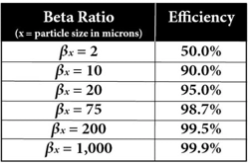
The ISO test method covers using particle counters and test fluid that has contaminants added to it. Contaminants of a given specific particle size are counted off both before and after the filter, which is in a multi pass test stand.
Beware must be exercised when using beta ratios to compare filters because they do not take into account exact operating conditions such as flow undulations and changes in temperature.
Beta ratio also does not give any index of its dirt-holding capacity, the total amount of contaminant that can be confined by the filter all over its life, nor does it account for its steadiness or performance over time.
Nonetheless, beta ratios are an effective way of surveying the expected performance of filters.